
Devplan and the coordination tax
Why Grand invested in Devplan
By: Nathan Owen
I spent the better part of two decades building infrastructure software companies. The hardest part was never writing the code. It was the work around the work: status updates, the “where are we on this,” the standing meetings that existed only to get everyone back in sync. Every team I ever ran paid that tax, and it was always treated as the cost of doing business in a software company.
AI has changed one half of that equation. Building software is faster and now cheaper than it ever been. Coordinating software engineers, product managers, project managers, QA and everybody else involved around that work, and now the agents too, hasn’t decreased at all. If anything, shipping faster has made it worse. More code in flight, more to track, more to explain. The Atlassian State of Teams 2026 report puts the cost of that fragmentation at roughly $161 billion a year across the Fortune 500. They call it the “AI fragmentation tax”.
That gap is why Grand Ventures invested in Devplan‘s $2.5M seed round, led by AI2 Incubator alongside Acequia Capital, Mighty Capital, and eLab Ventures.
The bet: when one half of a workflow gets cheap, value shifts to what’s still slow
Make any expensive task (like creating code) nearly free and the bottleneck relocates. AI coding tools made generation cheap, so the primary constraints move upstream and sideways, into context, alignment, and decision-making. Solving that isn’t really a new feature that can be glommed onto an existing tool, it’s a new layer that needs to exist, and prior to DevPlan, didn’t really exist in the wild.
Weaver
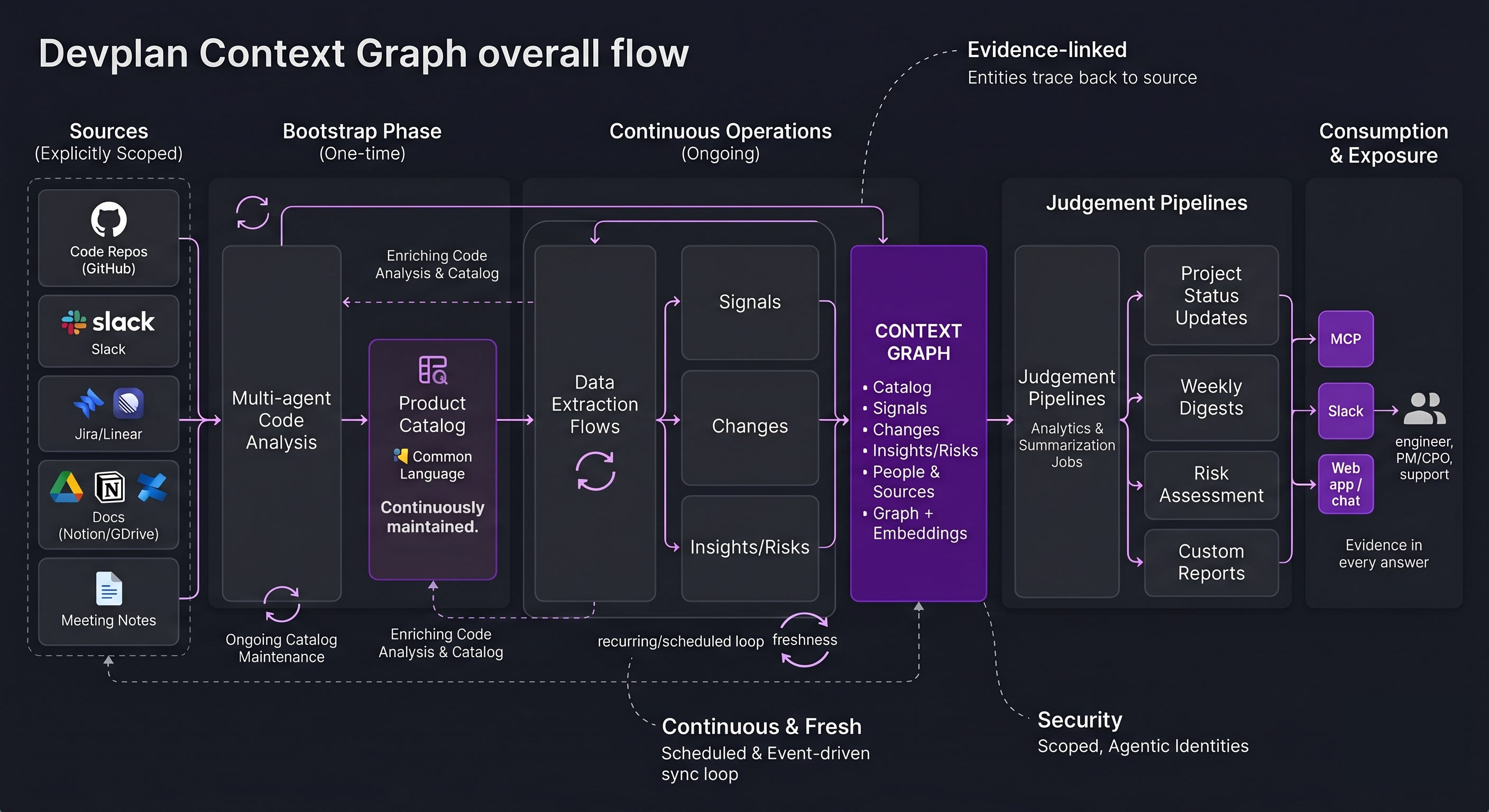
Devplan is building the intelligence layer for AI-native product development. Its engine, Weaver, connects the tools teams already live in (GitHub, Jira, Linear, Slack, Notion, Google Workspace, meeting notes, customer feedback) into a single organizational context graph. Instead of manual status reports and stale roadmaps, product and engineering leaders get a real-time read on what changed, what’s at risk, and what needs attention. And because that same context feeds both people and AI agents, the agents get better too.
A few early numbers stood out to us during our diligence on Devlan:
- When performing diligence calls with some of Devplan’s customers, product managers reported getting back 8-12 hours a week previously lost to coordination work when using Devplan. That’s significant.
- In internal benchmarking against a standard Claude configuration with GitHub connected over MCP, a moderately complex product-context query ran roughly 2x faster and more than 3.5x cheaper through Weaver because it was maintaining context continuously instead of re-assembling it on every query.
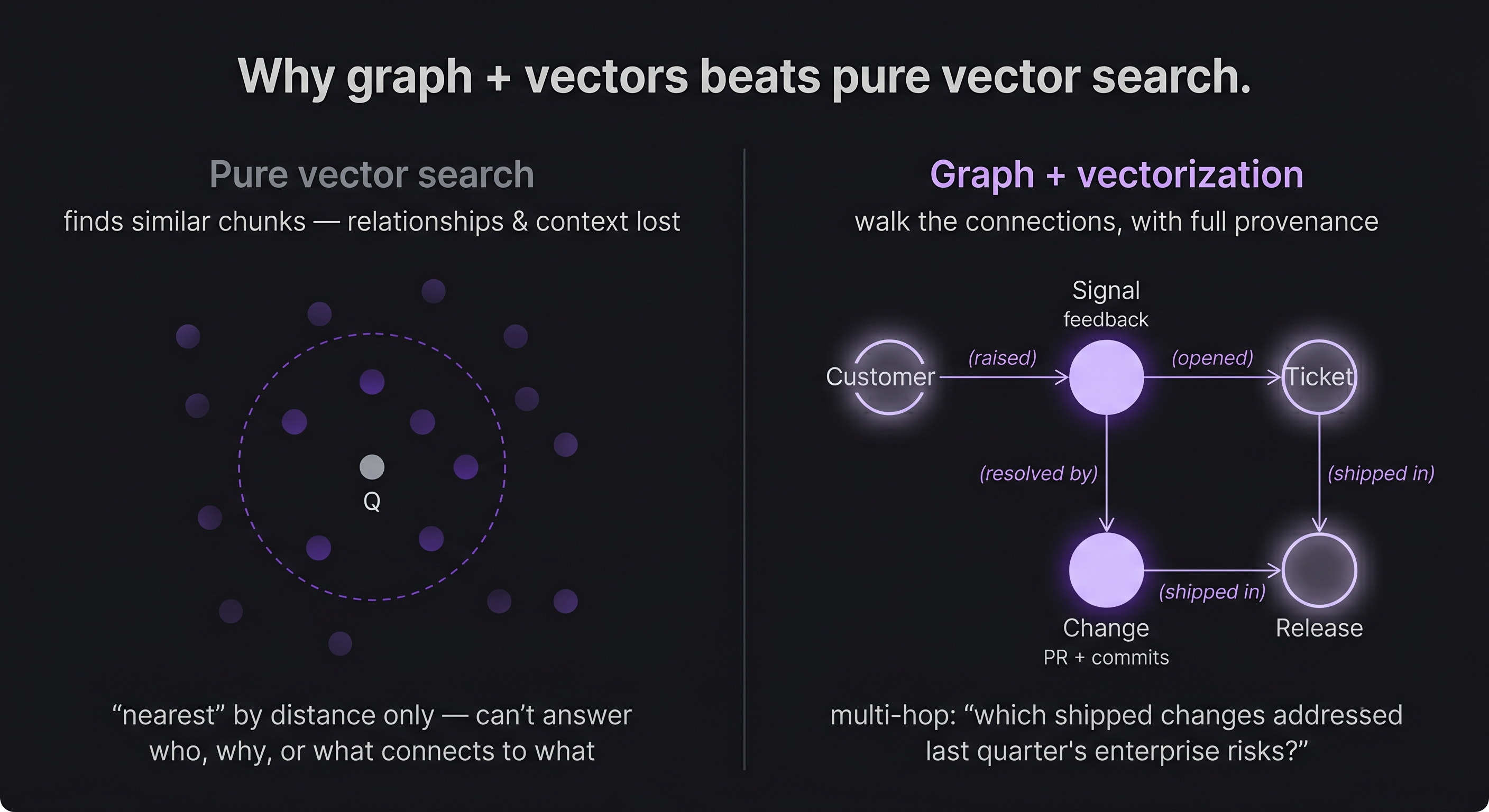
The architecture underneath matters. Most retrieval systems embed everything into a vector store and search by similarity. That’s good at telling you two things are both “about onboarding,” and useless at telling you that this complaint caused that ticket, which got fixed by this PR and shipped in that release. Those are relationship questions, and Devplan’s context graph answers them.
The founders
Chris Bee and Anton Safonov have lived this problem at scale, at Uber, Amazon, Snap, and Facebook. They aren’t theorizing about the coordination tax. They spent years being part of and leading software development organizations that paid the coordination tax. Those insights Chris/Anton gained provided them the technical depth needed to build the graph that sits underneath the fix. Operators who personally lived this pain with the engineering chops to solve it. That’s the founder profile Grand looks for.
The category is starting to taker shape. Atlassian’s Rovo, Snowflake’s CoWork, and GitHub Copilot all touch a piece of this. But each one comes at coordination from the seat it already owns: the issue tracker, the data warehouse, the code editor. Devplan starts from the product and engineering context itself. That’s the harder thing to build, and the more defensible place to stand.
Why Grand Ventures
Developer tools and DevOps sit at the center of our investment thesis. We’ve spent years building relationships and pattern recognition across that ecosystem, going back to our roots in observability and infrastructure software. We’ve backed enough developer-productivity companies to know the difference between a feature and a layer, and to help a strong team turn early inbound interest into a repeatable enterprise motion.
When you make one half of a workflow nearly free, the value migrates to whatever is still slow and expensive around it. Right now that’s coordination, and we’re glad to be backing Chris, Anton, and the Devplan team as they bring the future of product intelligence to market.