Three Exits, One Thesis
By: Nathan Owen, General Partner, Grand Ventures
Last month, Dynatrace closed its acquisition of Bindplane. That ended an 18-year journey that started in a 14×14’ office in Grand Rapids, Michigan, with a much smaller company and a much narrower idea of what we were trying to build.
I co-founded what eventually became Bindplane back in 2007 as Blue Medora, alongside Atomic Object, and served as CEO multiple times across its life. We sold management packs into the VMware, Oracle, and IBM observability ecosystems (back then we called it “monitoring”). It was a useful business. A decent one. Not a generational one. The pivot that mattered came years later, when we rebuilt the company as observIQ, then Bindplane, around a then-emerging open standard called OpenTelemetry (OTEL). We bet that the future of observability would be open, vendor-neutral, and controlled at the edge, not locked into a proprietary agent stack. Mike Kelly, my CTO at the time, was the prime driver behind that pivot and eventually drove the bet home as CEO. That’s the company Dynatrace acquired.
Bindplane wasn’t a Grand Ventures portfolio company; however, the lessons I learned operating it are the same ones that shape how I invest at Grand Ventures. I’m using the Bindplane close as a jumping-off point because it sits alongside two Grand Ventures Commercial Open Source Software (COSS) exits in the past year that tell the same underlying story.
Three Exits in Twelve Months
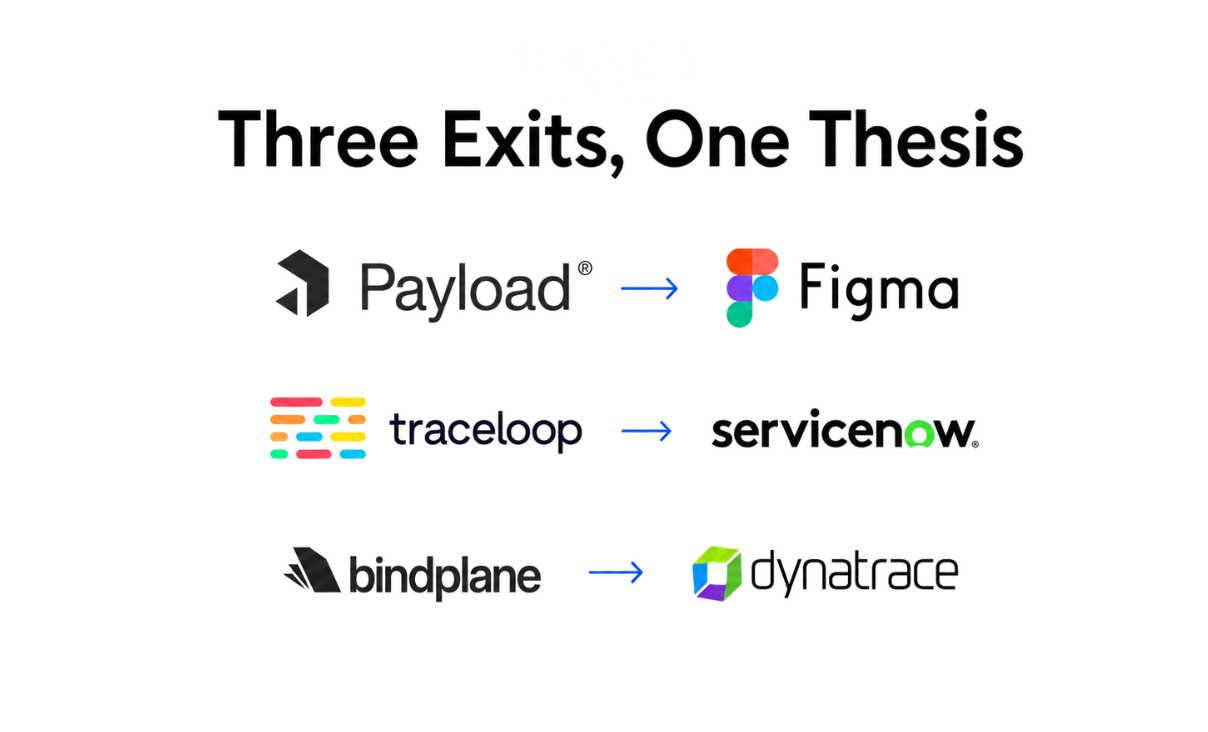
In roughly a year, three COSS companies I either led, invested in, or operated crossed the finish line.
Payload is a developer-first, open-source headless CMS founded by James Mikrut here in Grand Rapids. We invested in late 2021 when they were three founders with no revenue and no commercial product, but had one of the most thoughtfully architected open-source CMSs we’d seen. Figma acquired them in 2025. I wrote about it at the time: From Payload to Figma: A Journey of Bold Vision and Open Source Execution.
Traceloop, founded by Nir Gazit and Gal Kleinman, built OpenLLMetry, an OpenTelemetry-based open-source standard for AI/LLM observability. ServiceNow acquired them to power its AI Control Tower platform. The fact that ServiceNow acquired an OpenTelemetry-native startup to solve for an emerging problem like AI?LLM observability tells you where the gravity in this market is. More on the deal here: From Vibes to Visibility to ServiceNow
Bindplane. By the time it was acquired, Bindplane was the leading OpenTelemetry-based telemetry pipeline and control plane. That position was earned, slowly, by contributing more and more to the OTEL project. A few examples:
- Bindplane donated Stanza in 2020, which became the OTEL Collector’s core logging library by 2023.
- Bindplane later co-designed OpAMP, which makes remote management of the OTEL collector possible.
- Bindplane built or enhanced more than 40 OTEL integrations (mostly receivers) that connect OTEL to technologies like Azure, CloudFlare, NGINX, and Windows Events.
Dynatrace acquired Bindplane to extend its platform upstream, into the part of the stack that handles telemetry before it ever hits Dynatrace’s analytics engine.
Three companies, three categories, three acquirers. One thing in common: each was built on or around an open standard or open-source project with a real community behind it.
Lessons Learned Operating a COSS company that I Now Use as an Investor
I’ve sat on both sides of this. I helped lead Bindplane through the OSS pivot. I watched what worked and what didn’t. Four things I now look for as an investor that I didn’t appreciate as cleanly when I was the one running the company:
The open standard does the distribution work for you, if you’re early. Bindplane’s OpenTelemetry bet looked risky in 2021. By 2024, OTEL was the second-most-active CNCF project. Traceloop’s OpenLLMetry play is on a similar curve. Companies that anchor to a rising open standard get pulled along by the community’s adoption. The ones that try to invent both the standard and the company at the same time rarely make it.
“Open source” isn’t a business model. It’s a go-to-market and a moat. Payload had no commercial product when we invested. What they had was a developer community that loved the product and would defend it on Hacker News, contribute features, and quietly pull it into the enterprise stacks at the companies they worked at. At the seed stage, that’s worth more than most ARR, because it compounds.

The hard part is the open-core / commercial dividing line, not the license. Where do you draw the line between what’s free and what’s paid? Get it wrong and you either suffocate the community or have nothing left to sell. Comp AI, another GV COSS company, is walking this line in real time. Bindplane navigated it by eventually building a full SaaS-based control plane. Payload navigated it by carefully layering in enterprise features and, now, integration with Figma. There’s no formula. But there is a discipline, and you can tell who has it.
Operating credibility matters in this category. Founders building COSS companies want investors who understand the difference between a GitHub star and a paying customer. I lived that translation problem for a decade. It’s part of why founders take our call.
The Grand Ventures COSS Portfolio Today
Beyond Payload and Traceloop, the rest of Grands Venture’s COSS portfolio reflects the same thesis.
Astronomer is built around Apache Airflow, the open-source workflow orchestration project that’s become the default for data engineering teams. It was our first investment out of our first fund at Grand Ventures, led by my Partner Tim Streit, and It’s become a category-definer in the COSS-based data ops category.
Comp AI is open-source compliance automation (SOC 2, ISO 27001, HIPAA, GDPR) that we co-led with OSS Capital. AGPLv3 core, AI-native, going directly at Vanta and Drata. The bet is that compliance is the next category where AI-native, open, and developer-first beats closed and seat-licensed.
One thing worth flagging: Traceloop’s OpenLLMetry and Bindplane’s OpenTelemetry collector, and Payload’s CMS contributions still ship as open-source projects after exit, with their communities intact. That’s the version of the COSS story that works for everyone. Founders get a great outcome, acquirers get accelerated distribution, and the community keeps the code they’ve been contributing to.
Where We Are Looking Next
A few patterns I’m spending time on right now.
- OpenTelemetry-adjacent categories. OTel is becoming the substrate for observability, security telemetry, LLM tracing, and increasingly AI agent observability. Anywhere the standard is going, there are companies to build.
- AI-native rebuilds of legacy categories. Comp AI is the template: take a category dominated by closed, slow, expensive incumbents and rebuild it open-source, AI-first, and developer-led. GRC was the first one. There are several more.
- Open standards for AI agents. This is still early and noisy, but a real standard is going to emerge, and the company that anchors to it the way Bindplane anchored to OTel will be a big deal.
Closing Thought
When I look at Bindplane → Dynatrace, Payload → Figma, and Traceloop → ServiceNow side by side, the takeaway isn’t that COSS is having a moment. It’s that the largest enterprise software companies in the world keep deciding it’s cheaper and faster to buy a great open-source-native company than to clone its community. That dynamic isn’t going away. AI probably accelerates it, since AI shortens the time to build a proprietary alternative but doesn’t shorten the time it takes to grow a real community around one.
I’m grateful to the Bindplane team, Mike Kelly, previous and existing employees, the partners, the investors, and the broader OTEL community for the last leg of an 18-year journey. And I’m grateful to the founders across the Grand Ventures portfolio who keep proving the thesis from the investor side.
We’re investing in more of them. If you’re building a COSS company at the infrastructure, observability, developer tooling, or devOps, come talk to us.
— Nathan
For more essays and insights from Nathan, follow his Substack here.