Why Grand Invested in OllyGarden
An OpenTelemetry expert in every repository
by: Nathan Owen
I spent two decades building companies that move telemetry around, first at Blue Medora and then Bindplane. I watched the bill for telemetry go from what was essentially a rounding error to the major line item that gets a CFO calling the VP of Engineering on a Saturday morning…
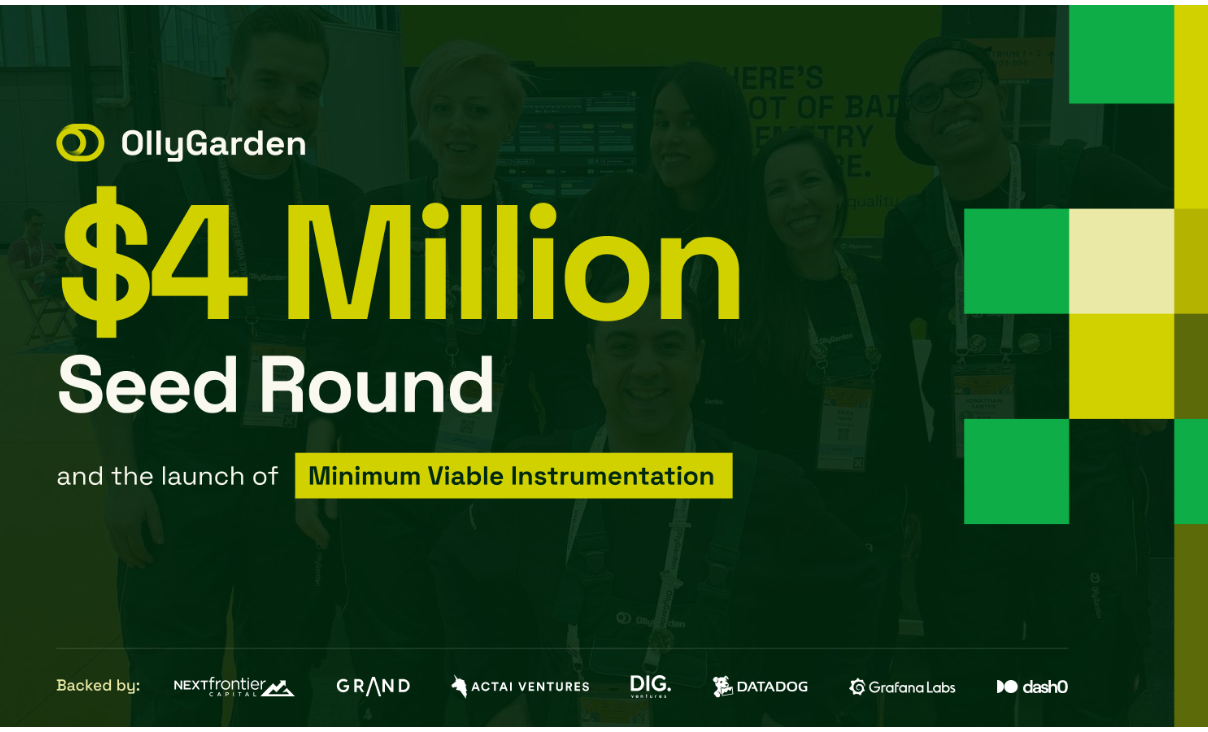
So when Juraci Paixão Kröhling told me he was starting a company to fix telemetry at the source, I paid attention. Grand has invested in OllyGarden’s $4M seed round alongside Next Frontier Capital and ACTAI Ventures. Existing investor DIG Ventures, who backed OllyGarden at inception, doubled down, and three of the leading companies in observability made further strategic investments: Datadog, Grafana Labs, and Dash0. Read OllyGarden’s announcement for the full details.
The problem: too much data, missing context
Logs, metrics, and traces give engineers a way to understand what their software is doing. That data is telemetry. When something breaks, it is what the on-call engineer uses to work out what happened.
For many software companies, observability has become one of the largest infrastructure costs outside of compute. I have heard more than one engineering leader say their observability bill is higher than their AWS bill. Much of that spending goes toward duplicate logs, traces nobody queries, or metrics whose cardinality has exploded because of a single attribute. In OllyGarden’s own audits, one fintech had 82% duplicate logs, another company was wasting 63% of its trace data, and five of six had credentials or personal data leaking into telemetry.
A high telemetry bill does not mean a team has good visibility. A service can generate thousands of traces without recording the business operation that failed or the context needed to investigate it. Filtering can reduce the noise, but it cannot add information the code never captured.
The industry’s answer for the last decade has been to filter the data downstream. I know, because I built one of those answers. Pipelines like Bindplane and Cribl route, sample, and drop data after it has been generated. Those pipelines are useful, but the code still produces the same bad telemetry. Filtering it becomes an ongoing job.
Coding agents can generate instrumentation with the same problems, while AI agents increasingly use telemetry to investigate incidents and decide what to do. Those agents need useful signals about the code running in production. Missing context matters just as much as a duplicate log or a misleading trace.
What OllyGarden does
OllyGarden’s platform works on the instrumentation itself. Its main product, Rose, reads a repository and proposes changes through pull requests that engineers review. It is built on OpenTelemetry and works with the observability backend a team already uses, including Datadog and Grafana.
With Minimum Viable Instrumentation (MVI), launched alongside the round, Rose also helps teams instrument services that lack useful telemetry. It starts with a plan for the service boundaries to cover, sets up OpenTelemetry, and adds the business context needed to investigate problems. Where it can run the application, it checks that the instrumentation actually produces data before opening the pull request.
That is what got me excited about OllyGarden. I spent years helping teams manage telemetry after it had been generated. With MVI, OllyGarden help teams decide what their software should report in the first place. The plan, configuration, and code changes stay in the customer’s repository, and engineers decide what merges.
Rose also reviews and improves existing instrumentation. When I watched it, Rose caught a customer name leaking into logs through a toString call and proposed the fix. One early result stood out: a paying customer cut roughly a quarter of its log volume and a fifth of its metrics, beating the targets it signed up for, and found a sensitive data leak along the way.
OllyGarden Insights helps teams assess the telemetry they already produce, scoring its quality and showing where it is breaking down. In a demo on one bank’s data, it found duplicate logs worth 40 to 50% of ingestion within minutes.
The founder: Juraci
Juraci was the primary driver of Grand’s decision to invest in OllyGarden.
Juraci sits on the OpenTelemetry Governance Committee, is a CNCF Ambassador, and is an emeritus maintainer of Jaeger. Before OllyGarden, he was a principal engineer at Grafana Labs and before that at Red Hat. He built core pieces of OTel itself, including the OpenTelemetry Operator and the Collector Builder. He also authored the Instrumentation Score, a vendor-neutral way to grade telemetry quality that six major observability vendors now support. That experience gives him a detailed understanding of the instrumentation OllyGarden is trying to improve.

One story stuck with me. Juraci found and fixed a memory issue affecting every deployment of a particular OpenTelemetry Collector build. When I asked him why he went looking, his answer was basically: “not on my watch”. He cares about these details enough to go looking for problems other people have missed. The people around him say the same thing. Every reference we ran through the OpenTelemetry community came back strong, and his former manager at Grafana described a leader who moves teams he does not control by finding where their interests line up. That is a rare skill in open source and a useful one in enterprise sales.
Why now, and why us
The timing matters for a few reasons.
OpenTelemetry has become the common standard. OTel graduated from the CNCF in May 2026 and is the second most active project in the foundation, behind only Kubernetes. As more teams adopt OTel, OllyGarden can work with the instrumentation they already use. I saw the value of building on that standard at Bindplane and Traceloop. It is one reason I am interested in OllyGarden.
Buyers have shown interest in telemetry tools. Several telemetry companies have been acquired in recent years. Calyptia went to Chronosphere, Onum to CrowdStrike, Observo AI to SentinelOne, and Bindplane to Dynatrace, while Cribl has kept growing on its own. Those companies focused on downstream pipelines. OllyGarden takes a different approach by fixing the instrumentation.
AI agents need reliable telemetry. As coding agents produce more software, teams need a way to keep its instrumentation useful. MVI gives Rose a way to establish that baseline, including in services that have little visibility today. That is why OllyGarden’s approach matters beyond the storage bill.
At Grand we invest in infrastructure and developer tools. We look for companies that help teams understand and monitor AI in production. Our investment in Traceloop came out of that work.
In early 2025, we invested in Traceloop. Traceloop was observability for AI. Nir Gazit and Gal Kleinman built OpenLLMetry, an open-source framework that extends OpenTelemetry to LLM applications: one line of code and you can trace every prompt, response, and model call in production. It caught on fast. IBM and Microsoft adopted it, and even competitors built on top of it. On that foundation, they built a platform for monitoring and evaluating AI quality in production. Our bet was simple: as AI moved from demos to production, enterprises would need to see what it was doing, and OpenTelemetry would be how they saw it. In March 2026, ServiceNow acquired Traceloop to power the observability layer of its AI Control Tower, about two and a half years after the company was founded.
Traceloop helped teams see what their AI applications were doing. OllyGarden addresses a related problem: helping teams instrument the code so they and their agents have useful data to work with. MVI makes that connection more concrete.
This is my home turf. I know the buyers, the pipelines, the politics of open source standards, and the specific ways observability companies stall. I have made most of those mistakes myself. If some of that experience can help Juraci skip a few of them, even better.
What comes next
The seed round will fund OllyGarden’s first go-to-market team. Today, almost all of its leads and revenue come through the OTel community, with no paid marketing. The next step is to build a sales process that reaches customers beyond that community.
Thanks for reading Nathan Owen’s Substack! This post is public, so feel free to share it.
If you run a platform or observability team and want to understand how much of your telemetry is useful, take a look at ollygarden.com.
Congratulations to Juraci and the team. I am glad Grand gets to be part of this.