From Vibes to Visibility to ServiceNow
Why an AI-native open source bet on OpenTelemetry was always going to work
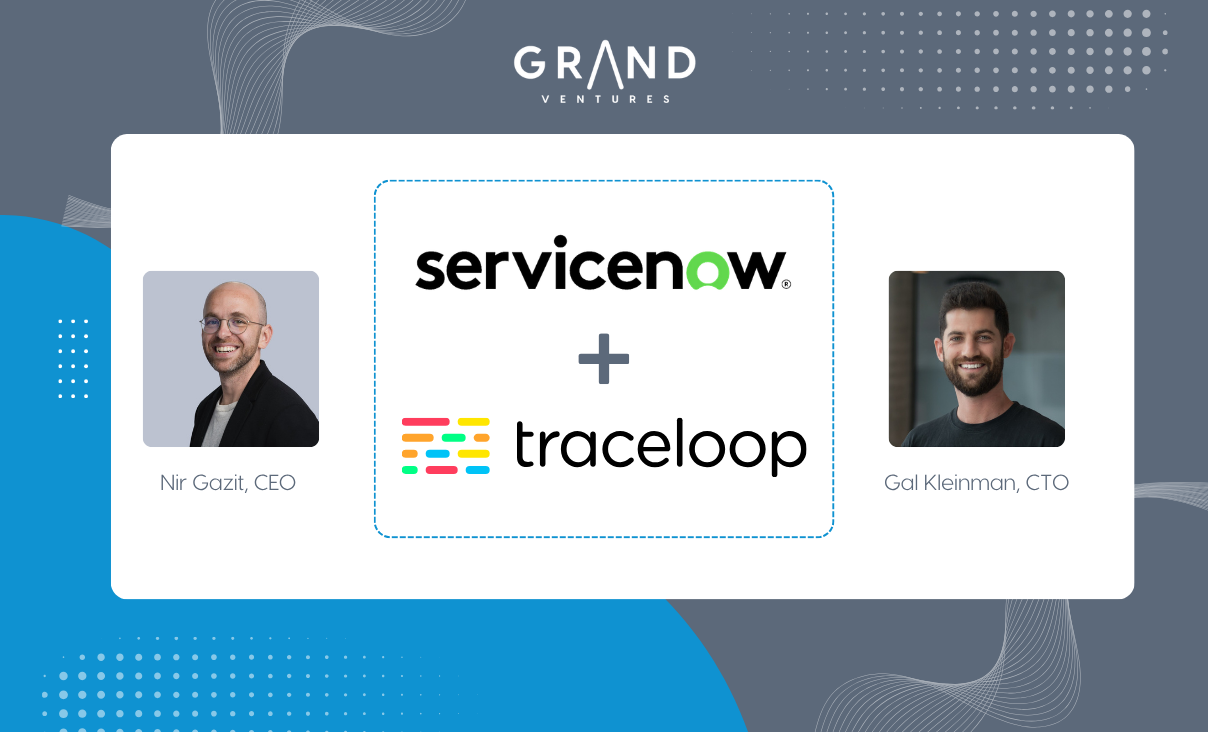
Last week, Traceloop announced it is joining ServiceNow, where its technology will become part of AI Control Tower. Huge congrats to Nir Gazit, Gal Kleinman, and the entire team.
Grand is proud to have backed the company, and even more proud of how clearly this outcome validates several things we care deeply about: observability, specifically OpenTelemetry; commercial open source (COSS); strong technical founders; and AI-native infrastructure built for production, not demos.
When I wrote From Vibes to Visibility last spring, the core argument behind our investment in Traceloop was simple: AI agents create an entirely new class of blind spots. Hallucinations, drift, regressions, and runaway cost are not edge cases; they are what production AI looks like when nobody is watching. In The Evolution of Observability, I made a broader version of the same point: every new software paradigm creates new operational complexity, and observability has to evolve with it. Traceloop fits that thesis perfectly. It was never about forcing old-school APM onto LLM systems. It was about making prompt-driven software observable, testable, and governable from day one.
It also fits squarely into our COSS (Commercial Open Source) playbook. Last year, we wrote how the best OSS companies tend to show the same signals early: developer love, contributor energy, download velocity, and usage that turns into commercial pull. Traceloop had that shape. Traceloop’s OpenLLMetry, built on/for OpenTelemetry, gave developers a one-line path to instrument LLM workloads, and by the time we invested, it had already built serious open-source momentum: 500K+ monthly downloads, 50K+ weekly installs, and 60+ contributors. Most paid users were first discovering Traceloop through the open-source adoption. That is exactly the kind of bottom-up adoption and capital-efficient distribution model we want to back.
Just as important, the team had the right scars. Nir had built predictive ML systems at Google. Gal had led ML platform work at Fiverr. They had lived the problem firsthand, which matters a lot in infrastructure. One of the best early-stage signals is a team obsessed with a broken process they have actually experienced. That was Traceloop. They were not retrofitting an old category with an LLM wrapper; they built an AI-native product around traces, evaluations, drift detection, model experimentation, and prompt versioning from day one. That usually ends well.
And finally, the ServiceNow fit makes a ton of sense. ServiceNow launched AI Control Tower as a centralized system to govern, manage, secure, and measure AI agents, models, and workflows across the enterprise. What it needed was exactly what Traceloop built, not just visibility into what AI is doing, but how well it’s doing it, in real time, across every model and workflow. As AI moves from experimentation to mission-critical, that layer stops being nice-to-have; it becomes foundational.
ServiceNow’s acquisition of Traceloop is another proof point for Grand’s broader thesis: backing opinionated founders building in the open can create real strategic value, fast. Developer-first, AI-native, open infrastructure turns into real enterprise value when it solves a painful problem and is built by the right team. We believed that when we invested. We believe it even more now. Huge congrats again to the entire Traceloop crew. We’re grateful to have been part of the journey and excited to see what they build inside ServiceNow.